Google is doing a small test where it is paying publishers for using their content within the Google AI Overviews, AI Mode, Gemini and other AI search features. This is called the AI contribution pilot, something we actually spotted back in April 2026, but are now learning more about today.
"Google has been quietly scaling a pay-per-value AI licensing scheme for publishers. But critics say the program looks less like a meaningful payout and more like a legal fig leaf," Digiday reported this morning. When we covered this in April, I was unable to see the help document, and honestly, I am still unable to see it because I am not part of this pilot.
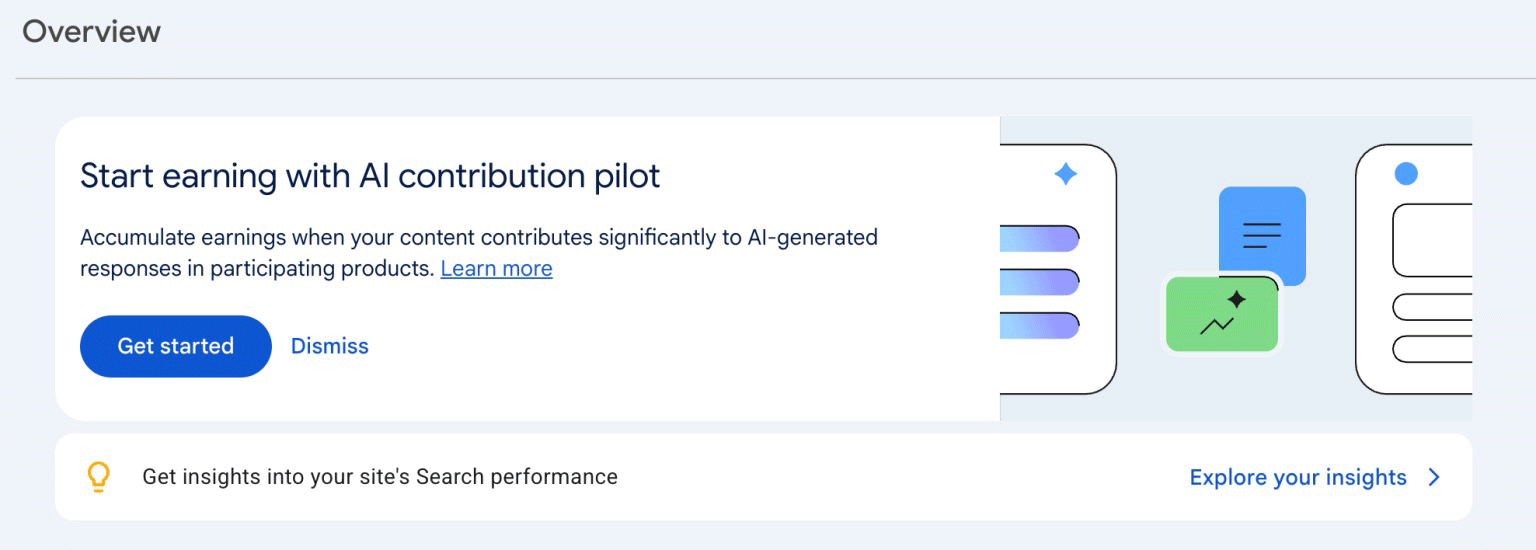
But Digiday has a copy of this help document and other screenshots. Here is the welcome screen to those publishers who have access to Al contribution pilot, it says, "Accumulate earnings when your content contributes significantly to AI-generated responses in participating products."
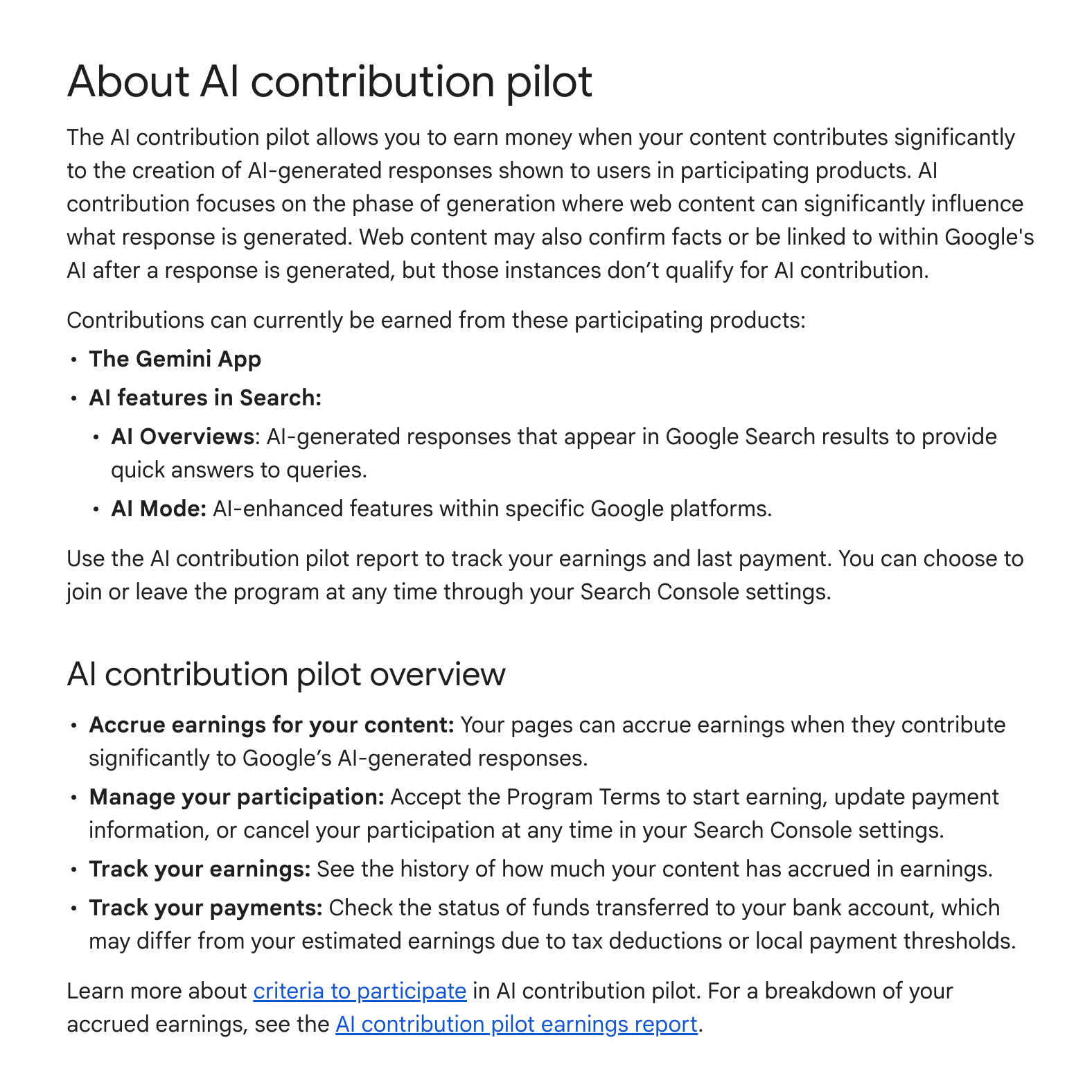
The help document explains:
The AI contribution pilot allows you to earn money when your content contributes significantly to the creation of AI-generated responses shown to users in participating products. Al contribution focuses on the phase of generation where web content can significantly influence what response is generated. Web content may also confirm facts or be linked to within Google's Al after a response is generated, but those instances don't qualify for Al contribution.
You earn from the Gemini app, AI Overviews and AI Mode. It goes on to say:
- Accrue earnings for your content: Your pages can accrue earnings when they contribute significantly to Google's AI-generated responses.
- Manage your participation: Accept the Program Terms to start earning, update payment information, or cancel your participation at any time in your Search Console settings.
- Track your earnings: See the history of how much your content has accrued in earnings.
- Track your payments: Check the status of funds transferred to your bank account, which may differ from your estimated earnings due to tax deductions or local payment thresholds.
Here is a screenshot:
The document should be located over here, I think, if you have access to the program.
Digiday said, "Google confirmed the scheme is an early-stage learning pilot to test how best to reward high-quality content, on top of the traffic and tools it already provides." It also said:
Once a publisher joins the “AI contribution pilot,” they receive an extra AI earnings widget via their Search Console dashboard. This displays a monthly earnings number (with some history), though no other detailed information on how payouts are calculated currently. Payments are based more on value than raw usage, meaning Google only pays when it judges that a piece of content has meaningfully contributed to an AI-generated response. Publishers can opt out at any time.Digiday has learned that at least dozens of publishers have been approached by Google for the AI contribution pilot, though the program has been more appealing to small and mid-sized, rather than large publishers and has widened far beyond news publishers. Digiday couldn’t get final confirmation of the number.
Do publishers like it? Digiday wrote:
Given the early stage of the program, Google is likely still figuring out how to determine the value each piece of content has for its AI-generated responses, and that’s a complicated equation no one in the industry has yet figured out.Two publisher execs who are part of the pilot but requested anonymity to speak freely conceded that while the information available so far is basic, it’s far better to be inside Google’s AI licensing tent, testing direct payments and data-sharing, than standing on the sidelines hoping the old referral economics return.
“Do I wish they were more transparent? Definitely,” said one publisher exec who is in the program. “But I’m hopeful that the fact that they’re setting a precedent for exploring paying publishers directly for content through this is meaningful,” they added.
Google is having weekly calls with some of the program partners, who described its approach as “extremely collaborative.” One exec said that they see the pilot less as a one-off deal and more of an early test of a marketplace for inference data, where publishers learn what’s valuable to AI systems as well as to readers. “What would be most interesting for us in the same way that Google Search Console historically has been a place where you can see what content performs in search… [is] that same feedback loop develop in the AI inference space,” they told Digiday.
Another program partner, who requested anonymity, said it’s early days for the program and so it’s not yet fully baked, but that Google has been in regular contact with them over progress. “What we’re looking for is real, meaningful collaboration in this super important area in which no one has really figured out the best way forward.”
He added that it’s critical that AI companies like Google aren’t “disincentivized” from collaborating, but are encouraged to do so. “We’re super excited to participate. The fact that we can have an open dialogue, share insights in a meaningful way and have a true partner, I feel like that’s so important,” he said.
I originally thought the AI contribution report was about the AI performance reports in Search Console when I first found it in April, but I guess it was more about paying publishers for content use in Google's AI features.
It is interesting this is a Search Console feature and not within Google Publisher Center or Google AdSense but that is a different story.
Forum discussion at X.