

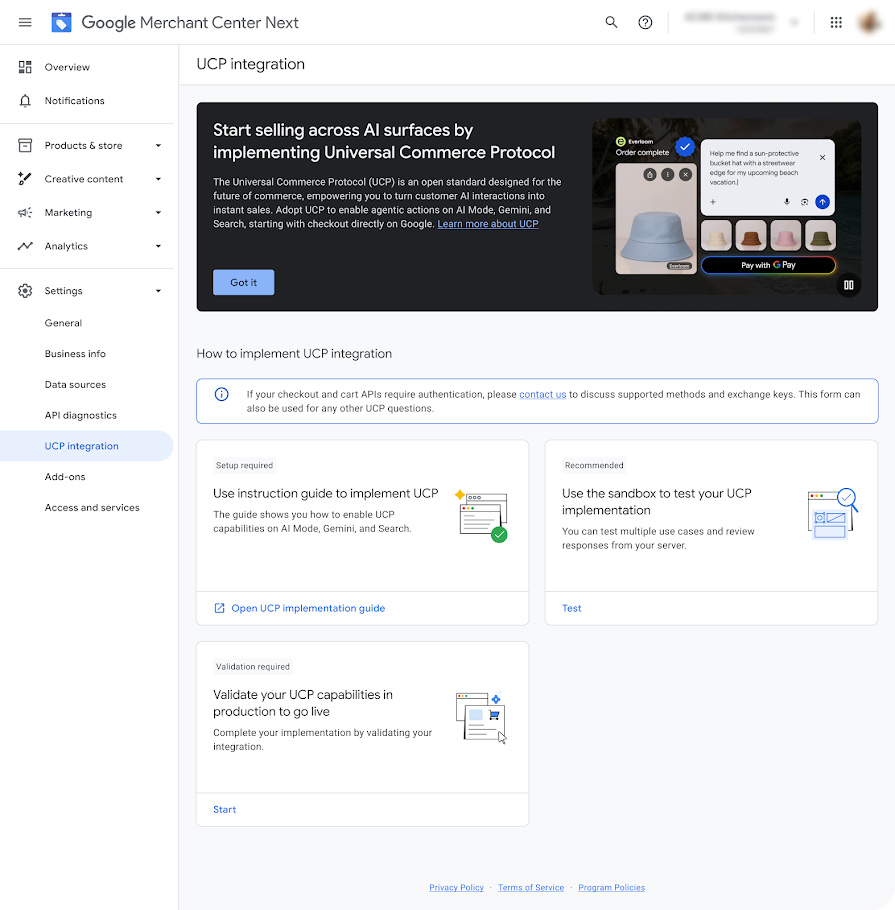
Google Merchant Center is rolling out the UCP integration hub in the United States. The UCP integration hub allows you to onboard to UCP program from your Merchant Center account.
The hub says "Start selling across AI surfaces by implementing Universal Commerce Protocol." "The Universal Commerce Protocol (UP) is an open standard designed for the future of commerce, empowering you to turn customer AI interactions into instant sales. Adopt UP to enable agentic actions on AI Mode, Gemini, and Search, starting with checkout directly on Google."
This was spotted by Hana Kobzova on PPC News where she shared this new Google help document discussing the UCP integration hub. It says:
The Universal Commerce Protocol (UCP) is a new open standard for agentic commerce that enables agents and systems to work together across the commerce ecosystem. By integrating with UCP, you can implement a checkout button on eligible product listings in AI Mode in Google Search and on Gemini.
The Merchant Center integration is gradually rolling out in the U.S. right now. Google said it will roll out later to Merchants in Australia and Canada next year. "This will allow you to onboard to the program from your Merchant Center account and enable capabilities like cart transfer to a merchant site and enhanced checkout flow testing," Google added.
Here is a screenshot of the UCP integration hub in Merchant Center:
To learn more, see the Google help document.
Google Merchant Center has been adding UCP features recently.
Forum discussion at X.
Update: It is rolling out in early November:
It’s live. The UCP integration hub just appeared in a client’s Merchant Center, and there’s a tab Google left out of the announcement.
Quick context: UCP (Universal Commerce Protocol) is Google’s new open standard for agentic commerce. It lets shoppers check out on free listings directly inside AI Mode and Gemini.
Google’s help doc covers onboarding: implement UCP, test in the sandbox, validate, go live.
What it doesn’t cover is the Analytics tab that is now showing for a client of mine.
Here’s what it tracks:
🛒 Transfers to merchant cart
The shopper builds a cart on Google, then gets handed off to your site to finish checkout.
→ Cart transfers → Average cart value → Average product count → Average product value
⚡ Native checkout on Google
The purchase is completed entirely on Google. The shopper never visits your site (but is credited to the organic shopping channel).
→ Buy button clicks → Purchase count → Average order value → Average product count → Average product value
🔗 Account linking
This tracks shoppers linking their account with your store, so things like loyalty and saved details can carry across into the AI experience.
Why this matters:
For the first time, you can measure agentic commerce as a separate channel. You’ll see how many sales start in AI Mode or Gemini, and whether they finish on Google or on your site.
If AI checkout takes off, “native checkout vs cart transfer” is going to be a big debate. Your share of conversions happening off-site is a metric that I will be curious to track for my clients that have opted in.
Rollout notes:
• Rolling out gradually in the US (it is showing for a US client of mine) • Australia and Canada are expected next year • Technical UCP implementation is required before onboarding
— Brodie Clark (@brodieseo) November 3, 2026